
← Home · Tax Enforcement
FBR's New Rs. 5 Per Unit Electricity Tax on Steel Companies: Who Pays More
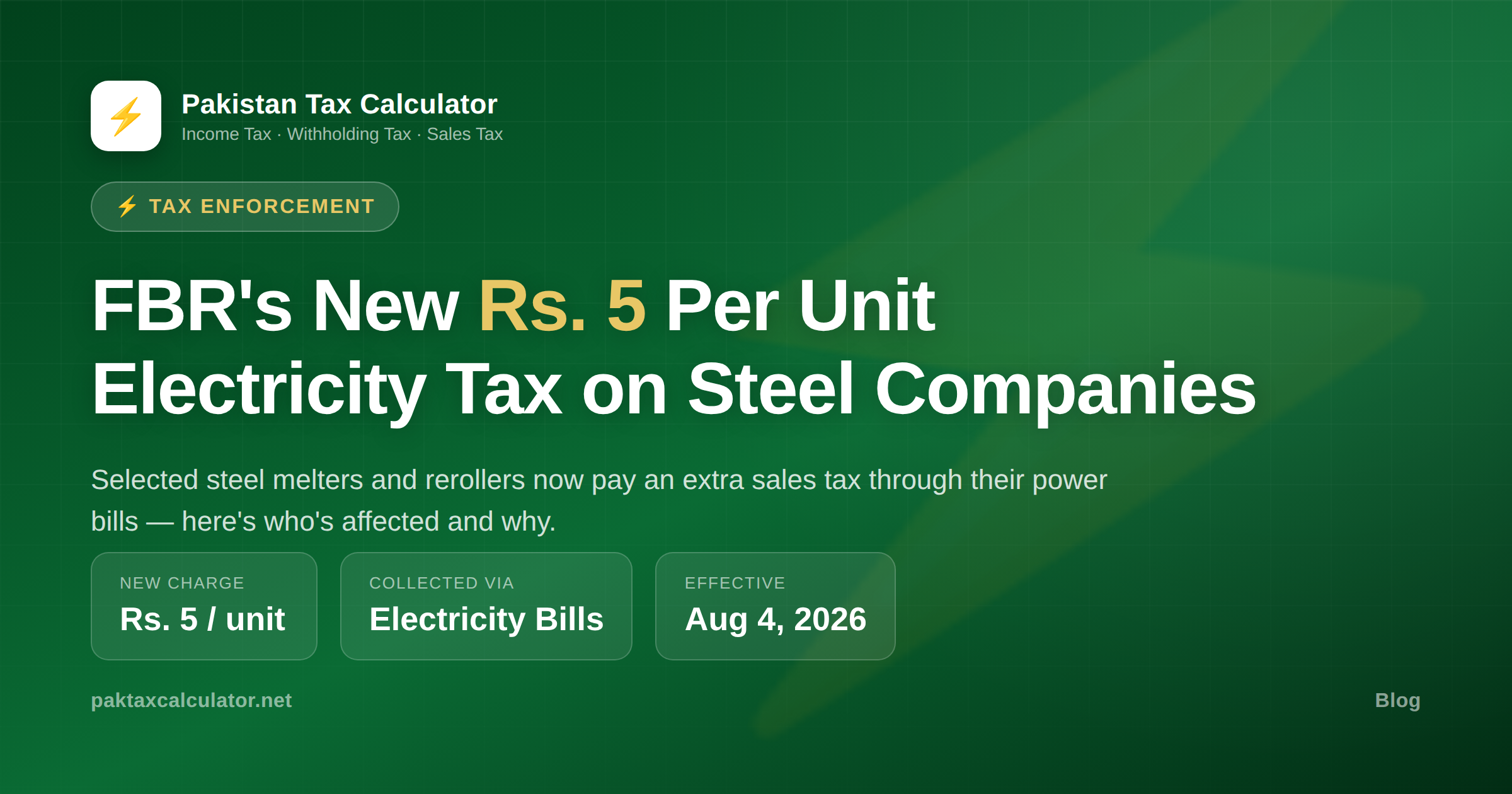
Pakistan's Federal Board of Revenue (FBR) has introduced a new Sales Tax General Order aimed at the steel sector, adding a fixed sales tax of Rs. 5 per unit of electricity for selected steel companies. The charge is collected directly through electricity bills rather than as a separate filing, tying it straight to how much power a company consumes.
What Changed
Announced on August 4, 2026, the order applies a sales tax of Rs. 5 per unit of electricity consumed by selected steel companies. Power distribution companies (DISCOs) are responsible for collecting the additional charge on FBR's behalf, folding it into the regular billing cycle instead of requiring companies to file or pay it separately.
Who Actually Pays It
The tax is not sector-wide. It applies specifically to:
- Steel melters
- Rerollers
- Composite steel units that meet FBR's specified criteria — particularly those that import steel scrap as a raw material
Only companies named in FBR's official notification are liable for the additional charge. Steel producers who are not on that list continue to be taxed under the existing rules, unaffected by this order.
Why FBR Introduced It
FBR says the change is meant to close long-standing documentation and compliance gaps in the steel sector, which has historically been difficult to monitor through conventional filing and inspection. In its statement, the board said the new system will “improve tax monitoring, increase documentation, and enhance revenue collection in Pakistan's steel industry,” and described it as building “a more efficient and transparent taxation framework.”
By billing the tax through electricity consumption, FBR sidesteps some of the usual enforcement problems that come with separate filings or physical inspections. Steel melting and rerolling are electricity-intensive processes, so power usage data from DISCOs works as a fairly reliable proxy for actual production volume — making it harder for affected companies to under-report output through their tax filings alone.
What It Means Going Forward
For the steel companies named in FBR's notification, the immediate effect is a direct increase in operating costs tied to electricity use, which is likely to be passed through into pricing to some degree. For the rest of the sector, it signals that FBR is leaning further into utility-linked, consumption-based tax collection for industries it considers under-documented — an approach that could be extended to other sectors if it proves effective at closing the tax gap.
Source: Reporting by Nayab Farooq Awan, Bloom Pakistan, August 5, 2026.
Check your own numbers. Use the Sales Tax (GST) Calculator to work out GST on goods, or the all-in-one invoice tool to check withholding and provincial sales tax on a supplier payment.